The roles and responsibilities of a teacher are extensive, even if one doesn’t take into account the many “hidden duties” of the profession. The last few years of teaching amidst the ever-changing conditions of the Covid-19 pandemic have made this evident; I would argue that these last few years have added duties and expectations, like learning how to completely shift teaching practice to a virtual method and enforcing health guidelines in classrooms. At times, this can make professional development and implementing new initiatives into their practice (a requirement of the job) sometimes fall to the bottom of the teacher priority list.
Fortunately, the Concerns Based Assessment Model (CBAM) for exploring innovations in teaching practice takes this into account, and as educator Susan Riley says on her podcast “it provides you with information on what professional development your teachers need, how to deliver your professional development effectively and provides opportunities to monitor teacher growth throughout a period of time.” If you’re unaware of CBAM, I encourage you to read more about it by listening to Episode 34 of Riley’s podcast SparkChasers, or read the show-notes here.
Let’s examine CBAM through the use of reference resources of two different teachers in their teaching practices. Megan and Liz (both pseudonyms) teach at the same inner-city middle school with 600 students in grades 6 to 8. Megan teaches grade eight and is at the start of her career (first 5 years); Liz teaches grade six, and is at the end of her career, likely retiring in five or so years. Megan was one of the teachers whose first year of teaching was disrupted by the Covid-19 pandemic, and her career has significantly been impacted by the continued effects of the pandemic. While Liz is a veteran teacher, she is new to teaching middle school, having taught elementary school for most of her career.
| Megan | Liz |
Stage of Concern | Megan is at the unconcerned/aware stage. She rarely connects with the teacher-librarian about accessing the LLC for its reference resources. Megan is very active in many aspects of the school, including running the leadership program and coaching in every season, so taking on change in her teaching practice isn’t always at the top of her priority list. | Liz is at the consequence stage. The self-reflection questions “How is [this] affecting learners? How can I refine it to have more impact?” are characteristic of Liz’s teaching practice (Loucks-Horsley, 2). |
Current Reference Resource Usage | It is unknown the extent to which Megan accesses reference resources in her classroom, but when her students do research projects that require reference resources, Megan often uses pre-made projects from sites like Teachers Pay Teachers but doesn’t confirm that the reference requirements of these projects suit the resources available in the LLC. An example: Megan recently brought her class in to the LLC for a Careers research project so that they could find a book on their chosen career path. Unfortunately, our LLC has very few books that would be helpful on this topic, so her students were largely unable to use their class time effectively. | Liz is a go-getter. She regularly brings her students to the library for reading materials and lets me know when she is working through specific units that she’ll need reference resources for. She is often able to find what she needs independently, but when looking for a large collection of reference books she’ll ask me to pull texts for her to use in her classroom. |
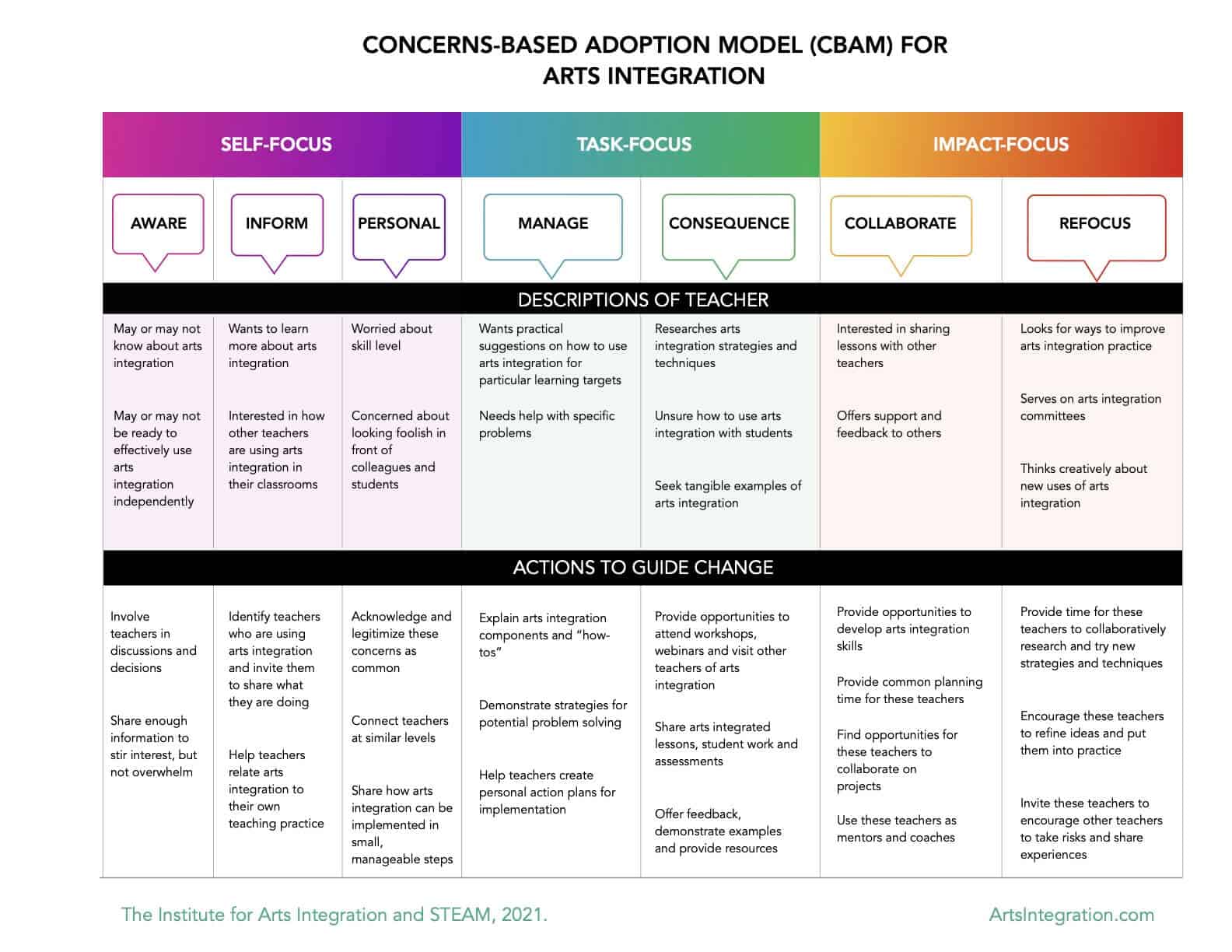
The following graphic shows CBAM through an Arts Integration perspective, but I’ve found it to be particularly helpful in creating a plan for how to help Megan and Liz progress to next stages of innovation via CBAM.
| Megan | Liz |
Next Stage Goal | Stage 1: Information | Stage 5: Collaborate |
Why this stage? | My goal with helping Megan move to the Information stage is to help her show what reference resources are available and how she can easily find the materials that her students will be able to use. | Liz is already very active in sharing ideas and information with colleagues (she created spearheaded the PBIS committee this year), but the “Actions to Guide Change” section of the Arts Integration infographic are very applicable to Liz. |
Potential Struggles & Limitations | Megan is a very independent person who does not like to accept help. She also has a very busy workload with her school involvement and tutoring outside of school, so persuading her to devote time to an aspect of her practice she is currently unconcerned about will be a significant challenge. | The final two stages of CBAM are that they move beyond the individual teacher and look at “spreading the wealth” with other teachers in the school. A big obstacle will be convincing other teachers or finding the time for other teachers to collaborate and learn from Liz. Additionally, it is not the TL’s responsibility to provide time for teachers to collaborate, which is a recommended action step. |
How will we get there? | While it seems basic, my first step would be to show Megan how to access the library catalog online so that she can search for whichever books she needs at any time (in fact, many teachers could use this information!). I would also then be able to show her how to access other reference resources that are housed in our catalog, like the various “Collections” that are together and the link to the online databases that our district has a subscription to. My second step would be to establish a more active working relationship. I would try to encourage her to let me know whenever she’ll be doing research with her class so that I can help her find resources. If able to establish more of a working relationship we could have avoided the incident of her students spending time looking for books that the library didn’t have and getting frustrated. I could have communicated that physical books would have been challenging to find but suggested that if she wanted her students to find non-website resources, they could have still used the laptops to find podcasts about their chosen careers, or even sent emails to people they know in those careers asking for more information. | Because Liz is already actively using reference resources and reflecting on their usefulness with students, I will be taking a leadership role to help Liz progress to the next stage. I can facilitate and organize opportunities for multiple teachers to come together in a small group to collaborate and learn from each other (and Liz) about the use of reference resources in their teaching. This would also be a chance to receive feedback from the about the gaps in the LLC collection and what reference resources could be helpful additions for our students. |
The roots of both plans stem from the question “How can I help?” but the ways in which that help would be offered are drastically different. With Liz, the help would be provided in a more “facilitator” and “resource manager” role, while with Megan the help would need to be basic and direct, yet subtle. Each present their own challenges, but with time these goals can be accomplished.
Resources
Loucks-Horsley, S. (1996). Professional Development for Science Education: A Critical and Immediate Challenge. The Concerns-Based Adoption Model (CBAM): A Model for Change in Individuals.
Retrieved February 17, 2023, from https://s3.wp.wsu.edu/uploads/sites/731/2015/07/CBAM-explanation.pdf
Riley, Susan. “CBAM for Learning Readiness (Sparkchasers Episode 34 | Show Notes).” The Institute for Arts Integration and STEAM, 19 Apr. 2021, artsintegration.com/2021/05/04/cbam.

Comments
Post a Comment